Super Bowl Sunday doesn’t have to wreck your stomach or your progress on semaglutide or tirzepatide. This practical game-day guide shows you exactly what to eat, what to avoid, how to handle social pressure, and how to reset the next day, without skipping doses or “saving up” calories.
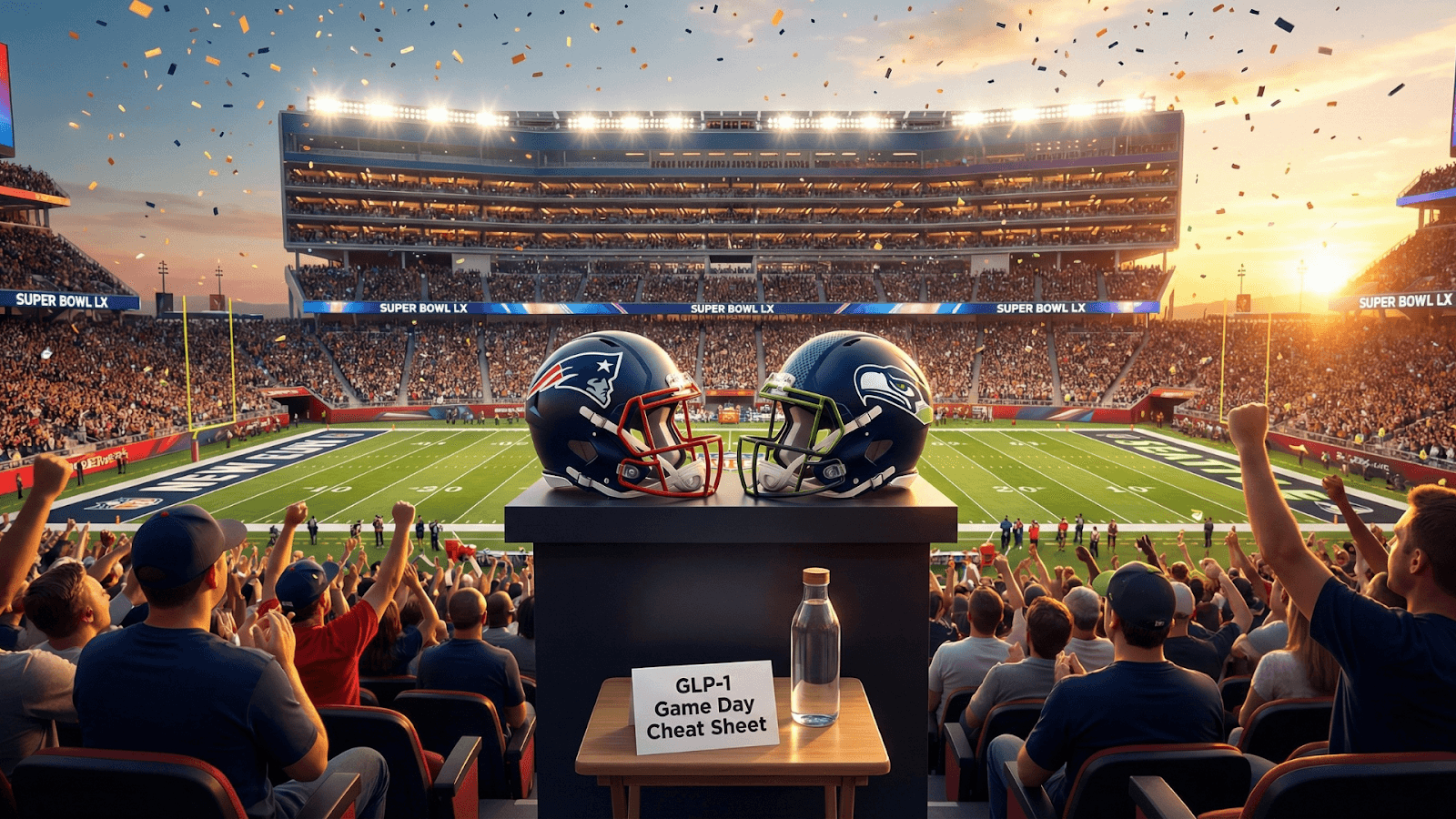
Super Bowl Sunday Survival Guide: Enjoying Game Day on GLP-1 Medications
- Guide
- Semaglutide
- Tirzepatide
- Uncategorized
- 29 min read
February 02, 2026
Your complete playbook for navigating America’s biggest food day while taking semaglutide or tirzepatide

The Super Bowl Dilemma: When America’s Biggest Food Day Meets Your Weight Loss Journey
Here’s what you’re probably thinking: “I’ve been doing great on my GLP-1 medication. My appetite is under control, I’m losing weight, and I feel amazing. But Super Bowl Sunday is coming, and I have no idea how to handle it.”
You’re not alone. In NRF’s most recent Super Bowl survey (conducted with Prosper Insights & Analytics for Super Bowl LIX in 2025), 203.4 million U.S. adults planned to watch and spending on food, drinks, and party gear was projected at $18.6 billion. Food traditions are still absurdly intense: the National Chicken Council projected 1.47 billion wings for that game alone.
Super Bowl LX (Super Bowl 60) is Sunday, February 8, 2026 at Levi’s Stadium in Santa Clara. Kickoff: 6:30 p.m. ET / 3:30 p.m. PT.
If you’re on semaglutide or tirzepatide, the thought of navigating buffalo wings, loaded nachos, beer, and desserts while managing delayed gastric emptying and reduced appetite might feel overwhelming. Maybe you’re worried about:
- Feeling uncomfortably full from just a few bites while everyone else is on their third plate
- Explaining why you’re not eating much without revealing your medication
- Missing out on the social experience because food no longer feels enjoyable
- Dealing with nausea or digestive discomfort from rich, fatty game day foods
- Losing your hard-earned progress from one indulgent day
The good news? You can absolutely enjoy Super Bowl Sunday on GLP-1 medications without derailing your progress or feeling miserable. This comprehensive guide will show you exactly how to do it, backed by science and real-world strategies from people who’ve successfully navigated game day while on weight loss medications.
Game Day Cheat Sheet: Your Quick Reference Guide
Before the Party:
- ✅ Eat a protein-rich breakfast (don’t skip meals to “save up”)
- ✅ Hydrate consistently throughout the day (64-80 oz total)
- ✅ Don’t change your dosing schedule for a party unless your prescriber tells you to
- ✅ Pack: water bottle, sugar-free gum, small protein snack as backup
At the Party:
- ✅ Survey all food before filling your plate
- ✅ Use a small plate and fill it: 50% protein, 30% vegetables, 20% treats
- ✅ Eat protein first, then vegetables, then everything else
- ✅ Put your fork down between bites—chew thoroughly and slow down
- ✅ Stop at satisfied, not full (on GLP-1s, the difference is just 2-3 bites)
What Works Best:
- ✅ Grilled proteins, shrimp cocktail, vegetable platters, baked chips with salsa
Approach With Caution:
- ⚠️ Fried foods, cream-based dips, pizza, carbonated drinks, alcohol
If You Feel Uncomfortably Full:
- ✅ Stop eating immediately, stay upright, sip water slowly, take a gentle walk
The Next Day:
- ✅ Resume normal routine immediately (no restriction or punishment)
- ✅ Hydrate well, eat regular meals, gentle movement only
- ✅ Skip the scale for 3-5 days (water weight fluctuations are normal)
Understanding How GLP-1 Medications Change Your Super Bowl Experience
Before we dive into strategies, let’s talk about why Super Bowl foods feel so different when you’re on semaglutide or tirzepatide. Understanding the science helps you make better decisions and avoid uncomfortable situations.
The Triple Effect: How GLP-1s Transform Your Relationship with Food
GLP-1 medications work through three primary mechanisms that fundamentally change how your body processes food:
1. Brain-Level Appetite Suppression
GLP-1 medications directly modulate brain regions controlling appetite, particularly in the hypothalamus. Research shows these drugs suppress AgRP neurons—the neurons that typically become active when your body loses weight and tries to protect you from starvation. By silencing these neurons, semaglutide and tirzepatide create what researchers call a “double whammy”: they both activate fullness signals in your brain stem AND prevent the rebound hunger that normally accompanies weight loss.
What this means for Super Bowl Sunday: You genuinely won’t feel hungry the way you used to. That plate of wings that would have been irresistible before? Your brain simply doesn’t register the same food reward signals. This isn’t willpower—it’s neurochemistry working in your favor.
2. Delayed Gastric Emptying
One of the most significant effects of GLP-1 medications is slowed gastric emptying. Your stomach literally takes longer to process food and move it into your small intestine. This creates prolonged feelings of fullness and satiety after eating.
What this means for Super Bowl Sunday: Rich, fatty foods—exactly the kind served at game day parties—sit in your stomach longer. That loaded nacho dip, those creamy chicken wings, that buttery pizza? They’ll feel heavy and uncomfortable much faster than they would have before medication. Foods that are high in fat and sugar are particularly problematic because they slow digestion even more, potentially leading to nausea, bloating, or that uncomfortable “stuck” feeling.
3. Reduced Caloric Intake Without Trying
Clinical studies show that tirzepatide significantly reduces energy intake compared to placebo. Semaglutide demonstrates similar effects, with users naturally consuming less without conscious restriction.
What this means for Super Bowl Sunday: You’ll likely eat significantly less than you’re used to—and that’s perfectly okay. A study found that people on GLP-1s naturally reduce their appetite, experience fewer food cravings, feel less tendency to overeat, and have decreased reactivity to foods in their environment. You’re not being “difficult” or “no fun”—your body is responding exactly as it should to the medication.
Why Traditional Game Day Foods Are Especially Challenging
Super Bowl snacks weren’t designed with GLP-1 users in mind. Here’s why they’re particularly problematic:
High-Fat Content: Buffalo wings with ranch dressing, loaded nachos with cheese and sour cream, pizza with extra cheese—these foods are very high in fat. With delayed gastric emptying, high-fat foods cause prolonged fullness that can quickly turn into discomfort.
Large Portions: Super Bowl parties can easily turn into a full-day grazing event, which hits differently when digestion is slowed. When your stomach processes food more slowly, these massive portions become overwhelming.
Rapid Eating: Game day eating is social and distracted. People tend to eat quickly while watching the game, not giving their delayed fullness signals time to register. On GLP-1s, eating too quickly almost guarantees discomfort.
Combination Foods: Super Bowl favorites combine the trifecta of difficult-to-digest components: fat + carbs + protein, often fried or heavily sauced. Your slower-moving digestive system struggles with these complex combinations.
The Good News: You Have More Control Than You Think
Here’s the encouraging part: unlike previous Super Bowls where you might have felt powerless around food, GLP-1 medications give you a neurological advantage. You’re not relying on willpower alone—your brain chemistry is fundamentally different. The challenge isn’t resisting temptation (that part actually becomes easier). The challenge is navigating social situations and managing expectations, both your own and others’.
Your Complete Game Day Strategy: Before, During, and After

Let’s break down exactly what to do on Super Bowl Sunday, hour by hour.
The Week Before: Setting Yourself Up for Success
Monday-Wednesday: Maintain Your Normal Routine
Don’t make the mistake of “saving up” calories or skipping meals in the days leading up to Super Bowl Sunday. This strategy backfires spectacularly on GLP-1 medications because:
- Your appetite is already suppressed—you’re not preventing overeating, you’re just making yourself feel worse
- Irregular eating patterns can worsen nausea, a common GLP-1 side effect
- Your body needs consistent nutrition to maintain muscle mass and energy levels
Instead, stick to your regular eating pattern. Focus on getting adequate protein intake (aim for 20-30g per meal) to preserve muscle mass, which is especially important since some weight loss can include lean mass—making protein and resistance training essential.
Thursday-Friday: Make Your Game Plan
If you’re hosting or attending a party, this is when you take control:
For Hosts:
- Plan to include at least 2-3 GLP-1-friendly options (more on this below)
- Buy smaller serving utensils so everyone naturally takes smaller portions
- Arrange food in stations rather than one overwhelming buffet
- Prepare cut vegetables, protein options, and lighter dips alongside traditional fare
For Guests:
- Offer to bring a dish you know works well for you
- Ask the host what they’re serving so you can plan accordingly
- Decide in advance which 1-2 items you’ll prioritize (the foods you genuinely love, not just what’s there)
- Consider eating a small, protein-rich snack before arriving so you’re not ravenous
Friday Night: Have Your Response Scripts Ready
Decide now how you’ll handle questions about your eating. Practice these responses:
- “I’m eating lighter these days and it’s working really well for me.”
- “I had a huge lunch, so I’m just nibbling.”
- “My stomach’s been a bit sensitive lately—I’m sticking to foods that sit well.”
- “I’m pacing myself so I can enjoy the whole game!”
- “Everything looks amazing, but I fill up quickly these days.”
Notice: None of these mention medication, weight loss, or dieting. They’re honest without oversharing.
Saturday: Prep Your Body and Mind
Hydration Is Critical
Start hydrating well before game day. Aim for 64-80 ounces of water throughout Saturday. Many GLP-1 users don’t feel thirsty but need fluids for optimal digestion. Dehydration can worsen nausea and constipation, two common side effects.
Take Your Medication as Scheduled
Whether you’re on a weekly injection or a daily tablet, follow your prescriber’s dosing schedule. If your medication day falls on Saturday or Sunday, don’t skip doses or adjust timing “to eat more” at the party. This creates inconsistent medication levels and often leads to worse outcomes.
Get Quality Sleep
Poor sleep increases hunger hormones and makes it harder to make good decisions. Aim for 7-9 hours.
Pack Your Game Day Kit
Prepare a small bag with:
- Sugar-free gum or mints (for when people offer food and you need something to do with your mouth)
- Antacid tablets (if you use them and your doctor approves)
- Water bottle (staying hydrated helps with satiety and digestion)
- One small protein bar or nuts (your safety food if nothing at the party works)
- Your medication if it’s your medication day
Super Bowl Sunday: Hour-by-Hour Playbook
Morning (8am-12pm): Set the Foundation
Don’t skip breakfast. This is critical. Eating a substantial protein-rich meal before the party prevents you from arriving overly hungry, which leads to eating too fast and overwhelming your slowed digestive system.
Ideal breakfast options:
- 2-3 eggs with vegetables and a slice of whole grain toast
- Greek yogurt (20-30g protein) with berries and nuts
- Protein smoothie with spinach, protein powder, banana, and nut butter
- Cottage cheese with fruit and a small portion of granola
Hydrate consistently. Drink 16-24 ounces of water with breakfast and continue sipping throughout the morning.
Move your body. A morning walk or light workout helps with digestion and reduces stress. Even 20-30 minutes makes a difference.
Afternoon (12pm-6pm): Pre-Party Preparation
If the party starts at kickoff (about 6:30 p.m. ET / 3:30 p.m. PT), you’ll want a light lunch around 12-1pm. This keeps your blood sugar stable and prevents arriving ravenous.
Light lunch options:
- Small salad with grilled chicken and vinaigrette dressing
- Half sandwich on whole grain bread with lean protein
- Vegetable soup with a side of hummus and vegetables
- Turkey and cheese roll-ups with an apple
Eat slowly and mindfully. Give your body time to register fullness—remember, signals are delayed on GLP-1 medications.
Continue hydrating. Aim for another 16-24 ounces of water between lunch and the party.
Party Time (Pre-Game Through Post-Game): The Main Event
Arriving at the Party (First 30 Minutes)
When you first arrive, resist the urge to immediately fill a plate. Instead:
- Survey the scene first. Walk around and see all the food options before making decisions. This prevents impulsive choices based on what’s nearest.
- Get a drink first. Start with water or a zero-calorie beverage. This gives you something to hold and helps with hydration.
- Position yourself away from food. Once you’ve gotten your food, move to a spot where you’re not directly next to the buffet. Out of sight, out of mind.
- Focus on conversation. Strike up chats with people. The more engaged you are socially, the less you’ll focus on food.
Building Your Plate (First Quarter)
When you’re ready to eat, use the protein-first approach:
First: Protein (50% of your small plate)
- Plain or grilled chicken wings (not fried, not sauced)
- Shrimp cocktail
- Meatballs (choose tomato-based sauce over cream-based)
- Deli meat roll-ups
- Grilled chicken skewers
- Turkey/chicken slices
Second: Vegetables (30% of your plate)
- Raw vegetables with a small amount of dip
- Green salad with vinaigrette
- Roasted vegetables
- Vegetable-based salsa
Last: Everything Else (20% of your plate)
- ONE item you truly love (not three)
- Small portions of crackers, chips, or bread
- A taste of a special dish
Critical plating strategy: Use a small plate (salad plate size). The visual of a full small plate is more satisfying than a partially filled large plate. Take small portions—you can always get more, but you can’t un-eat food that’s making you uncomfortable.
Eating During the Game (All Four Quarters)
Pace yourself ruthlessly. This is the most important rule for GLP-1 users at Super Bowl parties:
- Put your fork down between bites. Literally. Set it on your plate.
- Chew thoroughly. Take your time with each bite and really taste your food.
- Sip water between bites. This slows you down and aids digestion.
- Engage in conversation between bites. Talk, laugh, enjoy the social aspect.
- Wait 20-30 minutes before getting more food. Give your body time to register fullness.
Stop eating when you’re satisfied, not full. On GLP-1s, the difference between comfortably satisfied and uncomfortably stuffed is often just 2-3 more bites. Many users report feeling suddenly hit with fullness rather than a gradual progression. Stop before you reach that point.
The Halftime Snack Strategy (Second-Third Quarter)
If you want something during halftime, choose wisely:
Best choices:
- Fresh fruit
- Vegetable sticks
- One or two crackers with cheese
- A few nuts
- Shrimp cocktail
- Small serving of a vegetable-based dip
Approach with caution:
- Anything fried
- Heavy cream-based dips
- Pizza (the combination of cheese, bread, and fat can sit very heavy)
- Multiple desserts
Skip entirely:
- Carbonated drinks if you bloat easily
- Excessive alcohol (more on this below)
- Foods swimming in sauce or grease
Alcohol: A Special Consideration
Alcohol can feel different on GLP-1s. Many people report it’s less appealing and nausea can show up faster, and recent clinical trials suggest GLP-1s may reduce alcohol cravings in some people. If you drink, start small, go slow, and alternate with water.
If you choose to drink:
- Limit yourself to 1-2 drinks maximum
- Choose lower-calorie options (light beer, wine spritzer, spirits with soda water)
- Drink slowly—one drink per hour maximum
- Alternate each alcoholic drink with a full glass of water
- Eat protein before drinking to slow alcohol absorption
- Consider mocktails or zero-alcohol alternatives
Many GLP-1 users find that alcohol simply isn’t worth the side effects and opt for sparkling water with lime or other non-alcoholic options.
The Fourth Quarter: Managing Dessert
By the fourth quarter, you’ve likely already eaten. If dessert is being served and you want to participate:
The One-Bite Rule: Choose ONE dessert that you genuinely love. Take 2-3 small bites, eating slowly and mindfully. Savor each bite. Then stop. On GLP-1s, very sweet foods often become less appealing or even unpleasant after a small amount. This is your brain chemistry changing, not a personal failing.
Alternative: Take dessert home. Many people find they can’t eat dessert immediately after a meal on GLP-1s but might enjoy a small portion the next day.
It’s completely okay to skip dessert entirely. You don’t owe anyone an explanation.
Post-Game (10pm-Midnight): The Wind-Down
Hydrate generously. Drink 16-24 more ounces of water before bed. This helps with digestion and prevents next-day constipation (a common GLP-1 side effect).
Take a gentle walk. Even 10-15 minutes around the block or around your home aids digestion and helps food move through your system.
Don’t beat yourself up. If you ate more than planned or felt uncomfortably full at any point, that’s a learning experience, not a failure. GLP-1s work over time—one meal doesn’t undo your progress.
Plan for tomorrow. Get back to your normal routine immediately. Don’t punish yourself with restriction or exercise. Just return to your regular eating and medication schedule.
Monday After: The Reset
Return to normal immediately. This is crucial. Don’t try to “make up for” Sunday by skipping meals or over-exercising. Just resume your regular routine.
Monitor for digestive issues. Constipation and bloating are common after a heavy meal on GLP-1s. Increase fiber and water intake if needed.
Reflect and learn. What worked? What didn’t? Write down notes for future social events.
Celebrate the win. You navigated one of America’s biggest food days while on weight loss medication. That’s an accomplishment worth recognizing.
The Best and Worst Super Bowl Foods for GLP-1 Users

Let’s get specific about what to eat and what to avoid. This isn’t about restriction—it’s about choosing foods that will let you enjoy the day without physical discomfort.
✅ Best Choices: Foods That Work Well on GLP-1s
Proteins (Your Foundation)
Why they work: Protein takes longer to digest than carbs but shorter than fats, providing sustained fullness without the heavy feeling. Adequate protein also helps preserve muscle mass during weight loss.
Specific recommendations:
- Grilled or baked chicken wings (not fried, light sauce or dry rub)
- Shrimp cocktail with cocktail sauce (not heavy mayo-based dips)
- Turkey or chicken meatballs with marinara sauce
- Grilled chicken skewers or satay
- Deli meat roll-ups (turkey, roast beef, or ham with cheese)
- Hard-boiled eggs (if offered)
- Chicken or turkey chili (bean-based, not cream-based)
Portion size: 3-4 ounces (about the size of a deck of cards)
Vegetables (Your Volume Fillers)
Why they work: High in fiber and water, low in calories, and generally well-tolerated. They add volume to your plate without overwhelming your digestive system.
Specific recommendations:
- Raw vegetable platter: carrots, celery, bell peppers, cucumber, cherry tomatoes
- Green salad with vinaigrette dressing (not cream-based)
- Roasted vegetables: bell peppers, zucchini, asparagus
- Vegetable-based salsa or pico de gallo
- Pickles or pickled vegetables
- Steamed broccoli or cauliflower
Portion size: Fill half your small plate
Smart Carbohydrates (Choose Wisely)
Why they work: You can include some carbs, but choose ones that digest more easily and won’t sit heavily in your slowed stomach.
Specific recommendations:
- Baked tortilla chips (not fried) with salsa or guacamole
- Whole grain crackers (a few, not a pile)
- Popcorn (air-popped or lightly buttered, not movie theater butter)
- Fresh fruit (melon, berries, grapes)
- Pretzels (easier to digest than chips)
- One small slice of thin-crust pizza (if you’re truly craving it)
Portion size: 1/4 to 1/3 of your small plate
Lighter Dips and Sauces (Flavor Without Fat)
Why they work: Add flavor and moisture without the heavy fat content that causes discomfort on GLP-1s.
Specific recommendations:
- Salsa (any variety)
- Pico de gallo
- Guacamole (in moderation—avocados are healthy fat but still fat)
- Hummus (small portions)
- Cocktail sauce
- Marinara or tomato-based sauces
- Mustard
- Hot sauce
- Vinaigrette dressings
Portion size: 1-2 tablespoons per use
Beverages (Stay Hydrated)
Best options:
- Water (still or sparkling)
- Unsweetened iced tea
- Diet soda (in moderation—carbonation can cause bloating)
- Coffee or tea
- Sparkling water with lemon or lime
- Low-calorie sports drinks (if you need electrolytes)
⚠️ Approach With Caution: Foods That Are Challenging
These aren’t “forbidden,” but they’re more likely to cause discomfort on GLP-1s. If you choose to eat them, do so in very small portions and slowly.
High-Fat Proteins
- Fried chicken wings (the breading and frying oil sit very heavy)
- Bacon-wrapped anything (very high fat content)
- Sausages or hot dogs (high fat and preservatives)
- Chicken wings with cream-based sauces (Buffalo wings with blue cheese, etc.)
- Cheese-heavy dishes (cheese dip, cheese-stuffed jalapeños)
If you want them: Take 2-3 pieces maximum, eat very slowly, and skip other fatty foods that meal.
Heavy Carbohydrates
- Deep-fried mozzarella sticks
- Onion rings
- French fries
- Thick-crust or deep-dish pizza (the bread-to-topping ratio is problematic)
- Garlic bread (especially with butter or cheese)
- Biscuits or rolls with butter
If you want them: Choose ONE item, take a small portion, and make it your only significant carb.
Cream-Based Dips and Sauces
- Spinach artichoke dip (usually loaded with cream cheese, mayo, and cheese)
- Buffalo chicken dip (cream cheese and ranch-based)
- Queso (cheese and cream-based)
- Ranch dressing or dip (very high fat)
- Sour cream-based dips
- Blue cheese or ranch dipping sauce
If you want them: Use 1 tablespoon maximum and pair with vegetables, not chips.
Combination Foods (Fat + Carb + Protein)
- Loaded nachos (chips + cheese + sour cream + meat)
- Fully loaded baked potato skins (potato + bacon + cheese + sour cream)
- Pizza rolls or bagel bites (fried bread + cheese + toppings)
- Pigs in a blanket (sausage wrapped in pastry)
- Stuffed mushrooms (if cream cheese-based)
If you want them: Choose the smallest portion possible, eat it first when your stomach is most empty, and make it your only “challenging” food.
❌ Best to Skip: Foods That Cause the Most Problems
These foods are most likely to cause significant discomfort on GLP-1 medications due to their high fat content, heavy texture, or difficult-to-digest nature.
Extremely High-Fat Foods
- Anything deep-fried in batter (the combination of oil absorption and breading)
- Cheesy, creamy dips eaten in large amounts
- Fried mozzarella sticks
- Fried jalapeño poppers stuffed with cream cheese
- Seven-layer dip (layers of refried beans, sour cream, cheese, guacamole, etc.)
- Pork rinds (pure fat and very dense)
Why skip: The high fat content combined with delayed gastric emptying causes prolonged uncomfortable fullness, potential nausea, and even vomiting in some cases. Individual responses vary—if you experience severe or persistent symptoms, contact your healthcare provider.
Very Sweet or Rich Desserts
- Brownies or fudge (very dense and sweet)
- Cheesecake (extremely rich and heavy)
- Ice cream sundaes (the combination of cold, sweet, and dairy)
- Anything with heavy frosting
- Extremely sugary candies
Why skip: Many GLP-1 users find that very sweet foods become unpalatable or even cause nausea. The medications can change taste preferences, making intensely sweet foods less appealing.
Carbonated Alcoholic Beverages
- Beer (especially regular, not light)
- Hard seltzers (carbonation + alcohol)
- Champagne or sparkling wine
- Mixed drinks with soda
Why skip: The combination of carbonation (causes bloating), alcohol (unpredictable effects on GLP-1s), and often sugar creates the perfect storm for discomfort.
Large Portions of Anything
- Oversized sub sandwiches
- Giant burgers
- Heaping plates of anything
- Multiple trips to the buffet without waiting between
Why skip: Portion size matters more on GLP-1s than specific foods. Even “good” foods in large quantities will cause discomfort with delayed gastric emptying.
Navigating Social Situations: What to Say and Do

Let’s address the elephant in the room: people will notice you’re eating differently, and some will comment. Here’s how to handle it gracefully.
Common Scenarios and Recommended Responses
Scenario 1: “Why aren’t you eating more?”
What NOT to say: Long explanations about your medication, weight loss progress, or health issues.
What TO say:
- “I’m full! Everything was delicious.”
- “I fill up quickly these days—getting old!” (add a laugh)
- “I had a huge lunch and I’m still working through it.”
- “My stomach’s been a bit sensitive lately, so I’m taking it easy.”
Follow with: Change the subject immediately. “How about that play/commercial/halftime show?”
Scenario 2: “Come on, it’s Super Bowl Sunday! Have some fun!”
What NOT to say: Defensive responses about being “good” or “on a diet.”
What TO say:
- “I am having fun! This party is great.”
- “I’m enjoying myself—just not super hungry right now.”
- “I’m pacing myself so I can enjoy the whole game!”
- “I’m having plenty—this dip is amazing!” (while holding your plate)
If they persist: “I appreciate the offer, but I’m really satisfied. Thanks though!”
Scenario 3: “You’ve lost weight! Are you on those new drugs?”
What NOT to say: Detailed medical information or anything you’re uncomfortable sharing.
What TO say (if you want to share):
- “Yes, I’m working with my doctor on a medical weight loss plan and it’s going really well.”
- “I am! It’s been a great decision for my health.”
What TO say (if you don’t want to share):
- “I’ve made some changes that are working for me.”
- “Thanks for noticing! I’m feeling great.”
- “I’d rather not talk about my weight—how have you been?”
Remember: You never owe anyone details about your medical care. Ever.
Scenario 4: “Just one bite won’t hurt!”
What NOT to say: Apologetic responses that make it seem like you’re suffering.
What TO say:
- “I’m actually really satisfied—thanks though!”
- “Maybe later—I need to make some room first!”
- “It looks amazing! I might save some for tomorrow.”
- Simply, “No thank you,” with a smile and no explanation.
Body language tip: Say it kindly but firmly, then change the subject or move to a different conversation.
Scenario 5: Someone makes a comment about your small portions
What NOT to say: Anything defensive or apologetic.
What TO say:
- “Quality over quantity!” (with a smile)
- “I’m a grazer these days—I’ll probably come back for more later.”
- “This is actually perfect for me.”
- Simply ignore the comment and ask them a question about themselves.
Remember: Most people are focused on the game, the commercials, and their own plate—not monitoring what you’re eating.
Creating Your Safe Space at the Party
Position yourself strategically:
- Sit with supportive people who know about your medication
- Avoid standing directly next to the food table
- Face away from the buffet when possible
Stay engaged:
- Focus on conversation, games, and the actual game rather than food
- Keep hands busy with water bottle or activity
- Connect with others focused on the game, not grazing
Permission to leave: You can decline invitations or leave early if uncomfortable—your wellbeing matters most.
Special Considerations and Advanced Strategies
If You’re Hosting the Party
Hosting gives you maximum control over the food environment. Here’s how to make it work:
Menu Planning:
Include a variety of options that work well on GLP-1s while still offering traditional favorites:
Proteins:
- Grilled chicken wing bar with multiple dry rubs and light sauces on the side
- Turkey or chicken meatballs (offer both marinara and Swedish-style)
- Shrimp cocktail or grilled shrimp skewers
- Chicken chili (offer toppings on the side)
- Sliced turkey or ham platter
Vegetables and Sides:
- Large raw vegetable platter with hummus and one creamy dip option
- Green salad with several dressing choices
- Roasted vegetable platter
- Fruit platter
- Pickles and olives
Carbohydrates:
- Both baked and regular tortilla chips
- Whole grain crackers and regular crackers
- Popcorn bar with various toppings
- Small slider buns (for those who want them)
Dips and Sauces:
- Several salsas (mild, medium, hot)
- Guacamole
- Hummus (regular and flavored)
- One cheese dip for those who want it
- Hot sauce selection
Beverages:
- Large selection of waters (still and sparkling)
- Diet and regular sodas
- Unsweetened iced tea
- Beer and wine (if serving alcohol)
- Mocktail options
Serving Strategy:
- Use small serving utensils so everyone takes smaller portions naturally
- Serve food family-style or in stations rather than one overwhelming buffet
- Put healthier options at the beginning of the buffet line
- Offer smaller plates alongside regular dinner plates
- Keep food covered until serving time (reduces mindless grazing)
If You’re Traveling to Watch the Game
Medication: Keep in original packaging, use cooler for trips over 2 hours, carry-on only if flying
Food: Eat normally before traveling, pack protein snacks, stay hydrated
At destination: Bring backup protein options, ask host about menu in advance, offer to bring a dish
Managing Next-Day Effects
Constipation (Very Common)
Rich, fatty foods plus GLP-1s often mean constipation the next day.
Prevention:
- Drink extra water throughout game day and the next day
- Include fiber-rich vegetables in your meal
- Take a walk after eating
- Consider a fiber supplement the night of or morning after (if you already use one or your doctor approves)
Treatment if it happens:
- Increase water, gentle movement, warm beverages
- Consult your doctor about stool softeners if persistent and they’re appropriate for you
Nausea or Feeling Too Full
Stop eating immediately, sip water slowly, take a gentle walk, sit upright, and use deep breathing. If severe or persistent, contact your healthcare provider.
Bloating and Gas
Common from carbonated beverages, high-fiber foods eaten quickly, or unfamiliar foods. Manage with walking, peppermint tea, and over-the-counter relief (after checking with your doctor).
“Food Hangover” or Sluggishness
Return to your normal routine immediately—this feeling typically passes within 24-48 hours without intervention.
Building Your Custom Super Bowl Game Plan
Use this quick planning tool to personalize your approach:
My Strategy:
- Foods I’ll prioritize: _______________ (protein, vegetables)
- ONE treat I might include: _______________
- Foods I’m avoiding: _______________ (fried, heavy cream-based)
- Response to “Why aren’t you eating much?”: _______________
- Support person at party: _______________
My Success Metrics: I’ll consider this a success if: _______________
FAQ: Your Super Bowl Questions Answered
FAQ 1: Will eating too much on Super Bowl Sunday ruin my progress on semaglutide or tirzepatide?
Short answer: No, one meal will not ruin your progress.
Detailed answer: GLP-1 medications work by changing your overall relationship with food and your metabolic processes over time. Weight loss patterns on these medications occur consistently across weeks and months, not day by day.
Think of it this way: if you’ve been on your medication for several weeks or months, you’ve already had dozens of meals where you ate less, felt satisfied with smaller portions, and experienced reduced cravings. One larger meal on Super Bowl Sunday doesn’t erase that progress. Your medication is still working, your brain chemistry is still changed, and your stomach is still emptying more slowly.
The real risk isn’t “ruining progress”—it’s physical discomfort. Eating too much rich, fatty food when your digestion is slowed can make you feel terrible. Focus on staying comfortable rather than staying “perfect.”
Takeaway:
Most people find they can enjoy moderate portions of game day foods without derailing progress. The key is returning to your normal routine immediately the next day rather than trying to “compensate” through restriction. Your medication continues working regardless of one larger meal, and weekly weight trends matter far more than daily fluctuations. Focus on physical comfort during the event rather than perfection, and trust that consistency over time produces results.
FAQ 2: Can I drink alcohol on game day if I’m on GLP-1 medications?
Short answer: You can, but proceed with caution as alcohol may affect you differently on GLP-1 medications.
Detailed answer: Many people report that alcohol affects them differently while taking GLP-1 medications. The delayed gastric emptying caused by these medications means alcohol may stay in your stomach longer before being absorbed, which can create unpredictable effects. Some people report feeling the effects more quickly, while others experience increased nausea or digestive discomfort.
If you choose to drink:
Safe drinking guidelines on GLP-1s:
- Limit to 1-2 drinks maximum for the entire game
- Choose lower-calorie options (5 oz wine: ~120 calories; light beer: ~90-110 calories)
- Avoid sugary mixed drinks
- Never drink on an empty stomach—eat protein first
- Alternate each alcoholic drink with a full glass of water
- Drink slowly—one drink per hour at most
- Stop drinking 2-3 hours before the end of the party
Signs you’ve had too much:
- Feeling nauseous
- Dizziness or lightheadedness
- Sudden urge to eat everything in sight
- Disorientation beyond normal alcohol effects
Many people on GLP-1 medications find that alcohol simply isn’t worth the side effects and choose mocktails or non-alcoholic alternatives instead.
Takeaway:
Many people report that alcohol affects them differently on GLP-1 medications, often experiencing effects more quickly or with increased nausea due to delayed gastric emptying. While individual responses vary, starting with smaller amounts and monitoring your body’s reaction is the safest approach. If choosing to drink, strict personal limits are advisable: one to two drinks maximum for the entire event, consumed with food, alternated with water, and consumed slowly. Many users find that the unpredictable effects and potential for digestive discomfort make alcohol less appealing, opting instead for non-alcoholic alternatives. When in doubt, skipping alcohol entirely ensures you can fully enjoy the event without risking discomfort.
FAQ 3: What should I do if I feel uncomfortably full during the game?
Short answer: Stop eating immediately, move away from food, stay upright, sip water slowly, and take a gentle walk.
Detailed answer: Feeling uncomfortably full on GLP-1 medications happens more quickly than you might expect due to delayed gastric emptying. The difference between comfortably satisfied and uncomfortably stuffed can be just 2-3 bites, and the fullness sensation often hits suddenly rather than gradually.
Immediate relief strategies (0-30 minutes):
- Stop eating immediately. Put down your plate and step away from the food area—even if others are still eating.
- Stay upright. Sit in a comfortable chair or stand. Don’t lie down, as this can worsen the uncomfortable sensation and slow digestion further.
- Move to fresh air. Step outside, open a window, or move to a less crowded space away from food smells.
- Sip water slowly. Small sips of room temperature water can help, but avoid gulping or drinking large amounts, which can make fullness worse.
- Focus on slow, deep breathing. This helps with both physical discomfort and any anxiety about the situation.
30-60 minutes after:
- Take a gentle walk. Even 5-10 minutes of slow walking aids digestion and helps food move through your system
- Loosen tight clothing if needed for comfort
- Find a quiet space away from the party activity if you need it
- Use distraction techniques like watching the game, engaging in conversation, or focusing on something other than the fullness
What NOT to do:
- Don’t force yourself to continue eating to “not waste food”
- Don’t lie flat on a couch or bed
- Don’t drink carbonated beverages thinking they’ll help
- Don’t take medication without consulting your doctor first
- Don’t beat yourself up—this is a learning experience
Prevention for the rest of the game:
Once you feel better, if you decide to eat more later:
- Wait at least 60-90 minutes before considering more food
- Choose only the lightest options (vegetables, small protein portions)
- Eat half of what you think you want
- Put your fork down between every single bite
- Stop at the first hint of fullness
When to seek medical attention:
While uncomfortable fullness typically resolves on its own within a few hours, contact your healthcare provider if you experience:
- Severe, persistent pain (not just discomfort)
- Difficulty breathing
- Chest pain
- Symptoms that worsen rather than improve over 2-3 hours
- Inability to keep down water
Understanding the difference:
- Comfortable fullness: Satisfied, content, slightly full feeling. You could eat more but don’t need to.
- Uncomfortable fullness: Heavy, overly stuffed sensation, possible nausea, regret about eating more, difficulty focusing on anything else.
- Concerning fullness: Sharp pain, difficulty breathing, extreme nausea, dizziness.
The goal on GLP-1 medications is staying in the “comfortable fullness” range. If you cross into uncomfortable territory, use these strategies and remember the experience for next time.
Takeaway:
Uncomfortable fullness on GLP-1 medications typically results from eating just slightly too much or too quickly, as the delayed gastric emptying creates prolonged fullness that can feel overwhelming. The sensation usually peaks within 30-60 minutes and gradually improves with upright positioning, gentle movement, and time. Prevention remains the best strategy: eating slowly, stopping at satisfied rather than full, and paying close attention to early satiety signals. Most people find that experiencing uncomfortable fullness once teaches them valuable lessons about their body’s new signals and limits, making future events easier to navigate.
FAQ 4: Should I skip my medication dose if it falls on Super Bowl Sunday so I can eat more?
Short answer: Don’t skip or shift doses just to eat more unless your clinician specifically advises it.
Detailed answer: Skipping or delaying your GLP-1 medication to “eat more” at a party is a bad idea for several reasons:
Medical reasons:
- Medications work best with consistent levels in your system
- Skipping doses can cause blood sugar fluctuations
- You’ll lose therapeutic benefits that took weeks to build up
- It can take days for medication levels to stabilize again
- You may experience rebound hunger and cravings
Practical reasons:
- You probably won’t even want to eat that much—the medication has changed your appetite
- Eating large amounts after skipping a dose often leads to feeling terrible
- You’re setting up an unhealthy pattern of using medication inconsistently
- It undermines the entire purpose of weight management medication
The reality: Even if you follow your regular dosing schedule, you can still enjoy Super Bowl foods. You just need to choose wisely and eat smaller portions. One meal in the context of an overall balanced routine is not harmful.
What to do instead:
- Follow your prescriber’s dosing instructions
- Plan your food choices in advance
- Focus on protein and vegetables
- Allow yourself small portions of special foods
- Accept that you’ll eat less than pre-medication, and that’s okay
Takeaway:
Skipping your scheduled medication dose to “eat more” at a party undermines the entire purpose of medical weight management and creates medication inconsistency that takes days to recover from. Your appetite is already suppressed from previous doses, so skipping won’t dramatically increase hunger anyway. More importantly, taking your medication as prescribed allows you to still enjoy game day foods—just in smaller, more comfortable portions. The goal isn’t eating maximum quantities; it’s participating in the social experience while supporting your health. Consistency with medication timing produces the best long-term results, and one meal fits perfectly fine within that framework.
FAQ 5: What should I do if people keep commenting on how little I’m eating?
Short answer: Use pre-prepared responses, redirect conversation, and remember you don’t owe anyone explanations.
Detailed answer: Food-related comments are one of the most challenging aspects of social eating on GLP-1 medications. People notice when you’re eating less, and unfortunately, many feel entitled to comment.
Why people comment:
- Genuine concern (they think you’re sick)
- Projection (they feel self-conscious about their own eating)
- Social awkwardness (they don’t know what else to say)
- Nosiness (they want gossip)
Effective response strategies:
Option 1: Redirect with humor
- “I’m full! But there’s always room for [specific food], right?”
- “I’m pacing myself—this game has four quarters!”
- “Quality over quantity!” (with a smile)
Option 2: Simple and final
- “I’m satisfied, thanks!”
- “This is perfect for me.”
- “I appreciate your concern, but I’m good.”
Option 3: Deflect and change subject
- “I’m fine—did you see that play?”
- “I’m good! How have you been?”
- “Everything’s delicious—love your [recipe/outfit/etc.]”
Option 4: Honest but brief (if you’re comfortable)
- “I’m working with my doctor on some health stuff and eating lighter.”
- “My appetite has changed—it’s actually a good thing.”
What NOT to do:
- Apologize for your eating
- Provide detailed medical explanations unless you want to
- Let others dictate what you eat
- Feel guilty about taking care of your health
If comments persist or become rude:
- “[Name], I’ve answered that question. Let’s talk about something else.”
- “I’d rather not discuss my eating. Thanks for understanding.”
- Remove yourself from the conversation
- Leave the party if needed—your comfort matters more
FAQ 6: How do I handle the mental/emotional aspect of not being able to eat like I used to?
Short answer: Acknowledge the grief, reframe the experience, and focus on what you’re gaining rather than what you’re losing.
Detailed answer: This is one of the least discussed but most important aspects of being on GLP-1 medications. Food isn’t just fuel—it’s comfort, tradition, and connection. When your relationship with food changes dramatically, it’s normal to feel grief, confusion, or even identity loss.
Common emotional reactions:
- Grief over food traditions and favorite meals
- Feeling isolated or different from others
- Anxiety about social situations
- Identity confusion (“Who am I if I’m not a foodie?”)
- Guilt about taking medication
- Fear of judgment from others
Healthy reframing strategies:
Instead of: “I can’t enjoy food anymore.” Reframe as: “I’m learning to enjoy food differently. Quality matters more than quantity now.”
Instead of: “I’m missing out on the Super Bowl experience.” Reframe as: “I’m experiencing the Super Bowl differently—focused on the game, friends, and fun rather than just food.”
Instead of: “People will think I’m weird for eating less.” Reframe as: “People who care about me want me to be healthy and comfortable.”
Instead of: “I’ve lost my relationship with food.” Reframe as: “My relationship with food is evolving into something healthier.”
Practical coping strategies:
- Separate food from social connection. The party is about people and fun, not just eating. Focus on conversation, games, and connection.
- Create new traditions. Maybe Super Bowl Sunday becomes about hosting a fun environment, trying a new recipe, or starting a game day tradition that isn’t food-focused.
- Practice mindful eating. Really savor the small amounts you do eat. Taste every bite. Notice textures and flavors. Quality over quantity.
- Acknowledge the grief. It’s okay to miss your old relationship with food. That grief is valid. Talk about it with a therapist, support group, or trusted friend.
- Celebrate the wins. You’re healthier. Your body feels better. You’re not obsessing about food. These are huge victories worth acknowledging.
When to seek additional support:
- If food-related anxiety prevents you from attending social events
- If you’re restricting beyond what’s physically comfortable
- If you’re experiencing disordered eating patterns
- If grief about food changes lasts longer than a few months
Consider working with a therapist who specializes in weight management or food relationships.
FAQ 7: What if I’m the only one at the party on weight loss medication?
Short answer: You’re probably not the only one, but even if you are, you have every right to eat in a way that supports your health.
Detailed answer: With millions of Americans using GLP-1 medications, there’s a good chance you’re not the only one at the party, even if others haven’t disclosed it.
Reality check:
- Many people don’t announce they’re on medication
- Others might be eating lighter for different health reasons
- Some people just naturally eat less and no one comments
- Your medication is YOUR business—you don’t need to announce it
If you feel isolated:
- Connect with one supportive person. If someone at the party knows about your medication and is supportive, stay near them.
- Remember your “why.” You’re on this medication for important health reasons. That matters more than fitting in at one party.
- Focus on non-food aspects. Engage with the game, conversations, and activities rather than the food.
- Set boundaries. If people are pushy about food, you can politely but firmly decline. You don’t need to explain.
- Plan an exit strategy. If you’re truly uncomfortable, it’s okay to leave early. Your mental health matters.
Perspective shift: Most people at the party are focused on:
- Watching the game
- Their own conversations
- Their own plates
- Having fun
They’re NOT focused on monitoring your eating. We tend to think people notice more than they actually do.
FAQ 8: Can I meal prep or plan ahead to make game day easier?
Short answer: Absolutely! Preparation is one of the best strategies for success.
Detailed answer: Planning ahead removes decision-making pressure and ensures you have foods available that work well with your medication.
If you’re hosting:
Prep 2-3 days before:
- Make marinades, prepare vegetable platters, make lighter dips and chili (freezes well)
Day of:
- Cook proteins (grilled chicken, meatballs, shrimp) and assemble platters
If you’re attending:
Dishes to bring that work well on GLP-1s:
- Greek chicken skewers, turkey meatballs with marinara, shrimp cocktail, vegetable platter with humemade hummus, or chicken chili
Meal prep for the week after:
Have easy protein options ready for when appetite feels off:
- Hard-boiled eggs, grilled chicken portions, Greek yogurt, protein shakes, pre-portioned vegetables
FAQ 9: What if I accidentally eat too much and feel sick?
Short answer: Stop eating, rest, stay hydrated, and be gentle with yourself.
Detailed answer: It happens. Even with the best planning, you might misjudge your limits, eat too quickly, or choose foods that don’t sit well. Here’s how to manage:
Immediate steps (0-30 minutes after):
- Stop eating immediately. Put your plate down and step away from food.
- Remove yourself from the food area. Go outside for fresh air, move to a different room, or take a walk.
- Don’t lie down. Stay upright to aid digestion. Sit in a comfortable chair or walk slowly.
- Sip water slowly. Small sips, not gulps. Room temperature or slightly warm water is easier on your stomach than ice-cold.
- Focus on breathing. Deep, slow breaths can help with nausea.
What NOT to do:
- Don’t force yourself to vomit (unless medically necessary)
- Don’t eat or drink more “to feel better”
- Don’t take anti-nausea medication without doctor approval
- Don’t lie flat (this can make nausea worse)
30 minutes – 2 hours after:
- Gentle walking: Even 5-10 minutes of slow walking can aid digestion
- Fresh air: Open windows or step outside
- Ginger tea: Natural nausea relief
- Cool compress: On forehead if feeling flushed
- Peppermint: Tea or even smell can help
2-4 hours after:
By this point, you should start feeling better as food moves through your system. If you don’t:
- Continue hydration
- Consider a warm shower
- Rest in a quiet, dark room
- Use acupressure points for nausea (P6 point on inner wrist)
When to seek medical attention:
- Severe, persistent vomiting (more than 3 times)
- Unable to keep down water
- Severe abdominal pain
- Signs of dehydration (dizziness, dark urine, dry mouth)
- Symptoms lasting more than 24 hours
Learning from it:
After you feel better, reflect:
- What specifically did you eat that caused problems?
- Did you eat too quickly?
- Did you eat too much total volume?
- Were there trigger foods (very fatty, very sweet, etc.)?
Use this information for next time. This is data, not failure.
FAQ 10: How do I get back on track after Super Bowl Sunday?
Short answer: Resume your normal routine immediately—no punishment, no restriction, just consistency.
Detailed answer: The day after a bigger meal, many people feel the urge to “compensate” by restricting food, over-exercising, or feeling guilty. Resist this urge. The healthiest approach is simple: return to normal.
Monday Morning:
Do:
- Wake up at your normal time
- Follow your regular medication schedule (if it’s your medication day)
- Drink water immediately (16-24 oz)
- Eat your normal breakfast, even if you’re not hungry
- Move your body gently (walk, stretch, light yoga)
Don’t:
- Skip meals to “make up for” Sunday
- Step on the scale (weight fluctuates; give it a few days)
- Punish yourself with intense exercise
- Restrict calories drastically
- Feel guilty or ashamed
Monday-Wednesday: The Consistency Phase
Focus on these priorities:
- Hydration: Aim for 64-80 ounces of water daily. This helps with digestion and any constipation from richer foods.
- Protein at every meal: Get back to your target of 20-30g of protein per meal to support muscle mass and satiety.
- Regular meal timing: Eat at consistent times even if appetite is off. Your body needs the routine.
- Gentle movement: Walk, stretch, light activity. Exercise because it feels good, not as punishment.
- Quality sleep: Aim for 7-9 hours to support hormone regulation and recovery.
Dealing with scale fluctuations:
If you step on the scale Monday or Tuesday and see a higher number, don’t panic. This is likely:
- Water retention from sodium in processed foods
- Undigested food still in your system
- Natural fluctuation
Wait 3-5 days for a more accurate picture. Better yet, skip the scale entirely this week and focus on how you feel.
Addressing digestive issues:
Common post-game-day issues:
- Constipation: Increase water and fiber, gentle movement, consider a stool softener if your doctor recommends it
- Bloating: Peppermint tea, walking, avoid carbonation
- Sluggishness: This will pass; maintain routine and it typically resolves in 24-48 hours
The bigger picture:
One meal, even a larger one, is a tiny blip in your overall progress. If you’ve been on GLP-1 medication for weeks or months, you’ve had dozens of meals where you ate appropriately for your goals. One meal in the context of an overall balanced routine is not harmful.
Focus on:
- Consistency over perfection
- Progress over time, not day-to-day changes
- How you feel physically and mentally
- Sustainable habits you can maintain long-term
Final Thoughts: You’ve Got This
Super Bowl Sunday on GLP-1 medications doesn’t have to be stressful. Your relationship with food has changed, and that’s actually working in your favor—the appetite suppression and reduced cravings give you freedom from food obsession.
Remember:
Your medication is your ally. The changes you’re experiencing are benefits that support your health decisions.
One meal is just one meal. In the context of your overall progress, Super Bowl Sunday is a tiny blip. Consistency over time matters far more than perfection on any single day.
You don’t owe explanations. Eat what works for you, respond to questions gracefully, and prioritize your health.
Focus beyond food. The game, friends, and memories matter more than the buffet.
Most importantly: you’re not alone. Millions are navigating special events on weight loss medications. Give yourself grace, celebrate your wins, and remember you’re making lasting health changes.
Enjoy the game!
References
- United Food & Commercial Workers International Union. (2020). Super Bowl Sunday Second Highest Day of Food Consumption. Retrieved January 2026.
- National Retail Federation. (2025). Super Bowl Consumer Spending Data. Retrieved January 2026.
- National Football League. (2026). Super Bowl. Retrieved January 2026.
- National Chicken Council. (2025, January 30). Americans to Eat 1.47 Billion Chicken Wings for Super Bowl LIX. Retrieved January 2026.
- Food Processing. (2025, February 7). Super Bowl Sunday: The Ultimate Food & Bev Consumption Event. Retrieved January 2026.
- Retail Brew. (2025, February 6). How consumers will be spending on Super Bowl snacks this year. Retrieved January 2026.
- Frontiers in Clinical Diabetes and Healthcare. (2025, November 3). GLP-1 agonists and exercise: the future of lifestyle prioritization. Retrieved January 2026.
- Institute for Clinical and Economic Review. (2025, October 29). Semaglutide and Tirzepatide for Obesity: Effectiveness and Value. Retrieved January 2026.
- Northwestern Medicine News Center. (2025, October 23). Obesity Drugs Regulate Neural Systems to Curb Appetite. Retrieved January 2026.
- The American Journal of Medicine. (2025, January 30). Mechanisms of GLP-1 Receptor Agonist-Induced Weight Loss: A Review of Central and Peripheral Pathways in Appetite and Energy Regulation. Retrieved January 2026.
- Nature Medicine. (2025, June 24). Tirzepatide on ingestive behavior in adults with overweight or obesity: a randomized 6-week phase 1 trial. Retrieved January 2026.
- New England Journal of Medicine. (2025, May 11). Tirzepatide as Compared with Semaglutide for the Treatment of Obesity. Retrieved January 2026.
- JAMA Psychiatry. (2025, April 1). Once-Weekly Semaglutide in Adults With Alcohol Use Disorder: A Randomized Clinical Trial. Retrieved January 2026.
- Fancy Meds. (2025, November 7). Holiday Eating on GLP-1s: Smart Strategies to Avoid Setbacks. Retrieved January 2026.
- ScienceDirect. (2025, May 30). Nutritional priorities to support GLP-1 therapy for obesity: a joint Advisory from the American College of Lifestyle Medicine, the American Society for Nutrition, the Obesity Medicine Association, and The Obesity Society. Retrieved January 2026.
Medical Disclaimer: This article is for informational purposes only and is not a substitute for professional medical advice, diagnosis, or treatment. Always seek the advice of your physician or other qualified health provider with any questions you may have regarding a medical condition or medication. Never disregard professional medical advice or delay in seeking it because of something you have read in this article.